Release Management Automation
Release day is a scramble — sign-offs chased, changelog hunted, dependencies missed.
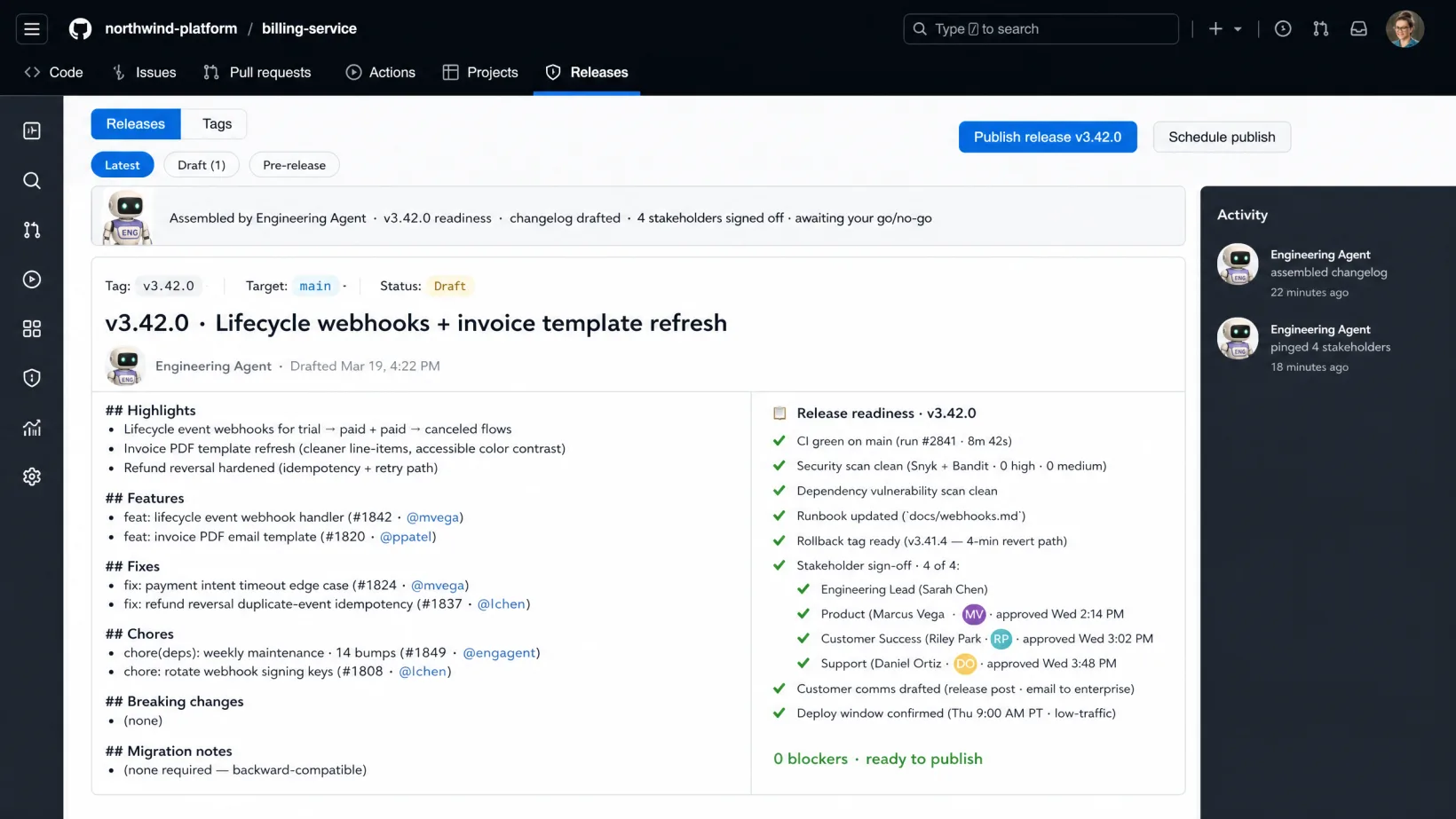
Release management software that checks readiness, drafts the changelog, lines up stakeholders, and assembles the data you need to call the go-no-go. You push the deploy when ready; agents handle everything around it.
~5 hrs/release back to you · readiness, changelog, stakeholders queued before you push
HOW IT WORKS
Three steps per release.
Managed service. We do the setup, the agent orchestration, the exception handling. You own the decisions.
Step 1
Agents check release readiness as the freeze approaches.
Pulled from GitHub, your continuous integration and deployment (CI/CD) pipelines, your test infrastructure, your incident tooling. Open PRs, failing tests, recent incidents, dependency changes — readiness checklist filled before the release captain opens it.
Step 2
Agents draft the changelog and the rollout plan.
Customer-facing changelog drafted from merged PRs. Internal release notes drafted from commits. Stakeholders to notify identified from CODEOWNERS and recent activity. Rollout sequencing proposed.
Step 3
Your release captain calls the go-no-go. Your team pushes the deploy.
One go-no-go review with readiness, changelog, and notification list. Approve to clear for deploy; reject to extend the freeze. Your team triggers the deploy in your existing CI/CD; agents notify the approved stakeholder list and watch the rollout health from your tooling, surfacing anything off for your call.
Where the line sits.
Agents run the repetitive work your VP Engineering / Head of Platform shouldn’t be doing. You stay in charge of the judgment.
Specifically, agents don't:
- Trigger a production deploy or rollback — those actions stay with your team. Agents prepare the data and notifications around them.
- Skip readiness checks because the release is ‘urgent’.
- Send a changelog to customers without your review of the wording.
A human approves anything that changes your books, your customers, your compliance posture, or your people. Every time.
YOUR DATA STAYS YOURS.
Agents read what they need to do the work. Nothing is stored on our side. Nothing is used to train models.
PRODUCTION-READY ON DAY ONE.
Every deployment includes governance and approval chains, role-based access control, monitoring, and model management.
Ready to pressure-test it?
Talk to an agent or drop a note. We'll come back with a proposal.
FAQ
Frequently Asked Questions
Yes. Continuous deployment gets readiness checks per merge; the changelog and stakeholder notifications batch by feature flag or release window. You set the rhythm.
Agents page your on-call and surface the runbook for the rollback decision. Your team executes the rollback per your process. Once the incident closes, agents draft the postmortem from the timeline.
No. We coordinate the release; LaunchDarkly still owns the flag system. Agents queue the flag changes as part of an approved rollout plan; your team flips them.
Three deployment options: our compliant environment, your cloud, or on-prem. Data stays in the perimeter you pick. Agents read inline to do the work — nothing copied, stored, or used to train models.
Let's look at your workflow together.
Talk it through with an operator now, or send a note. Tell us what's eating your week — we're here to take routine work off your team's plate so they move faster on what matters.

LIVE · TALK OR TYPE
Talk it through with your operator.
A few minutes with the operator who knows this kind of work. Tell them what's slowing you down; if it's a fit, we'll line up a human follow-up to take it further.
Talk or type — your choice. No phone number needed.
ASYNC · 1 BUSINESS DAY REPLY
Or send us your workflow.
Tell us what eats your week. We read every one and reply within a business day.