Code Review Queue Automation
Half the PR queue is still open on Friday afternoon. Again.
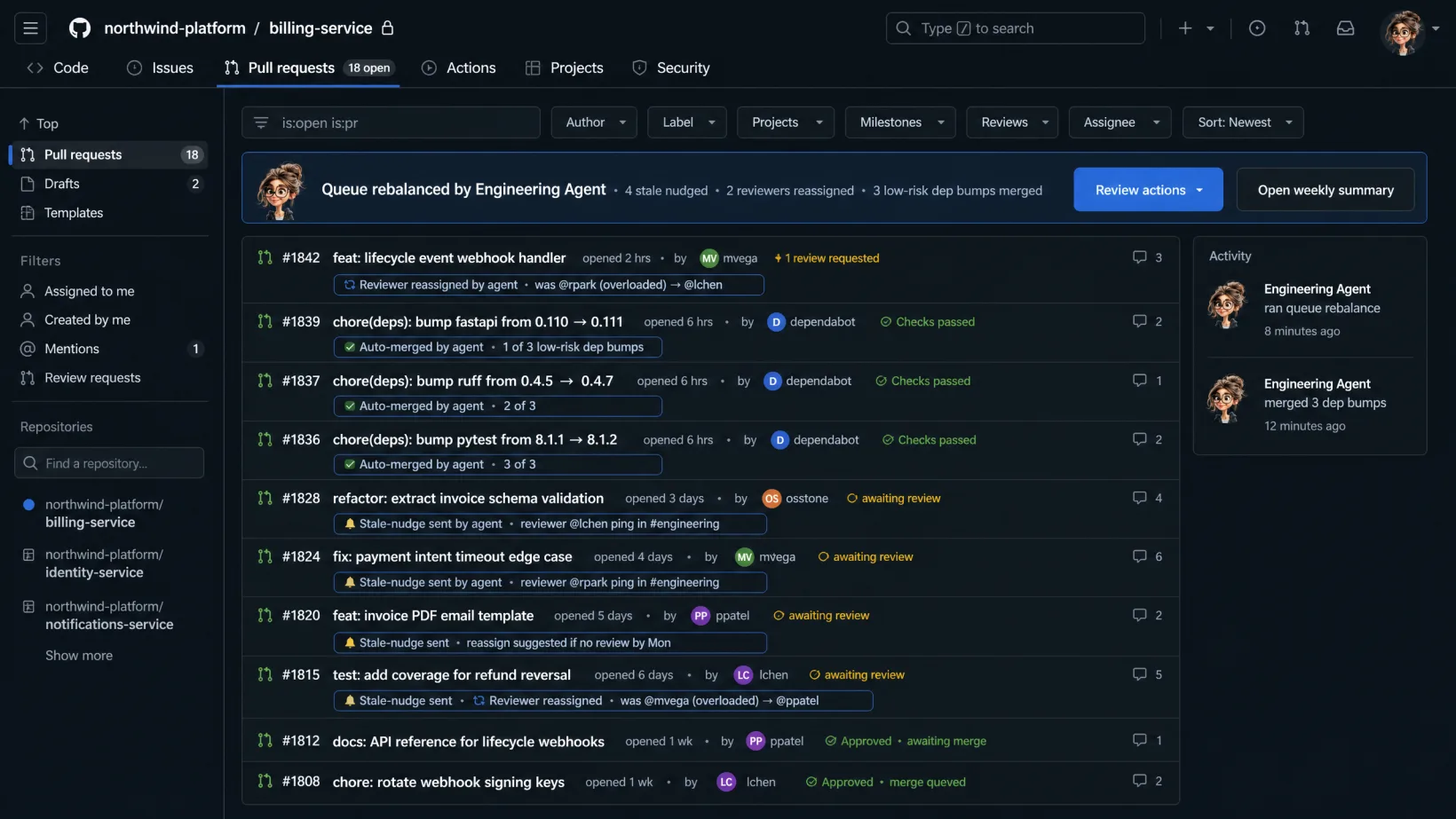
Code review automation that nudges stale PRs, rebalances reviewers when one is overloaded, and merges low-risk dependency updates after agent checks — only after you’ve set the rules. Senior reviewers see the changes that actually need them.
~4 hrs/wk back to you · PR queue kept moving, no Friday merge crunch
HOW IT WORKS
Three steps per PR.
Managed service. We do the setup, the agent orchestration, the exception handling. You own the decisions.
Step 1
Agents watch the review queue across your repos.
From GitHub, GitLab, or Bitbucket. Each open PR scored on age, reviewer load, blocking severity, and dependency criticality. Patterns surface: which repos have stale queues, which reviewers are buried, which PRs unblock the next sprint.
Step 2
Agents draft the actions. Each waits for your sign-off on the rule.
Stale PR? Nudge drafted in the author’s tone. Reviewer overloaded? Rebalance proposed with rationale. Trivial dependency PR? Merge proposed if all continuous integration (CI) checks pass and your manager pre-approved this auto-merge class. Each action carries the rule it ran.
Step 3
Your engineering manager approves the rules. Agents apply them daily.
Set the policy once: which PR classes nudge automatically, which can auto-merge with checks, which always need senior review. Agents apply the rules daily; exceptions and edge cases queue for your review.
Where the line sits.
Agents run the repetitive work your VP Engineering / Engineering Manager shouldn’t be doing. You stay in charge of the judgment.
Specifically, agents don't:
- Auto-merge a PR that touches a security boundary, even if it passes every CI check, without a human reviewer signing.
- Send a stale-PR nudge to an author in a tone that wasn't pre-calibrated with your engineering manager.
- Reassign a PR away from a reviewer without flagging the move and the reason.
A human approves anything that changes your books, your customers, your compliance posture, or your people. Every time.
YOUR DATA STAYS YOURS.
Agents read what they need to do the work. Nothing is stored on our side. Nothing is used to train models.
PRODUCTION-READY ON DAY ONE.
Every deployment includes governance and approval chains, role-based access control, monitoring, and model management.
Ready to pressure-test it?
Talk to an agent or drop a note. We'll come back with a proposal.
FAQ
Frequently Asked Questions
Yes. Auto-merge defaults to off. Your engineering manager picks which classes (if any) qualify — e.g. patch-level dependency updates with passing CI checks. Most teams enable nothing autonomous to start.
Every auto-merge class is pre-scoped by your manager. Regressions get flagged via incident management; the rule that allowed it gets reviewed and tightened.
Often it complements them. Renovate proposes the dependency updates; agents do the org-wide review-queue management and rebalancing. Different jobs.
Three deployment options: our compliant environment, your cloud, or on-prem. Data stays in the perimeter you pick. Agents read inline to do the work — nothing copied, stored, or used to train models.
Let's look at your workflow together.
Talk it through with an operator now, or send a note. Tell us what's eating your week — we're here to take routine work off your team's plate so they move faster on what matters.

LIVE · TALK OR TYPE
Talk it through with your operator.
A few minutes with the operator who knows this kind of work. Tell them what's slowing you down; if it's a fit, we'll line up a human follow-up to take it further.
Talk or type — your choice. No phone number needed.
ASYNC · 1 BUSINESS DAY REPLY
Or send us your workflow.
Tell us what eats your week. We read every one and reply within a business day.